Fire is one of the highest-risk threats to buildings—not only in terms of property damage, but also occupant safety and business continuity. Effective fire protection should not rely solely on “fire suppression” or “alarm systems.” It must also include systems that help slow down and contain the spread of fire from the very beginning.
One of the key concepts in modern building design is Passive Fire Protection (PFP)—a structural fire protection approach that focuses on using materials and design strategies to create fire compartments, limit the spread of fire and smoke, and provide critical time for evacuation and emergency response.
Fire-resistant precast walls are increasingly used in buildings, factories, warehouses, and high-safety projects. Precast concrete walls are inherently non-combustible and can be engineered to achieve the required fire performance for each project.
What Is the Difference Between “Fire Spread Control” and “Fire Resistance”?
The term fire spread control is often used together with fire-rated, but they serve different purposes:
- Fire Spread Control: Focuses on limiting the spread of fire and smoke from one area to another using fire barriers such as walls, floors, doors, and properly designed joints.
- Fire Resistance (Fire Rating): Refers to the ability of a building element (such as a wall) to maintain its function under high temperatures for a specified period—preventing collapse, stopping flame penetration, and limiting heat transfer.
In practice, a wall that effectively controls fire spread must also have appropriate fire resistance. Most importantly, joints and openings must be properly designed and installed. Even if the wall itself performs well, fire can penetrate through weak points.
Why Is Concrete Suitable for Fire Spread Control?
Concrete plays a crucial role in structural fire protection due to its inherent properties:
1) Non-Combustible Material
Concrete is inorganic and does not act as fuel, preventing it from contributing to fire spread.
2) Thermal Mass and Density
Its mass and thickness slow down heat transfer, helping maintain lower temperatures on the non-fire-exposed side for a period of time—critical for evacuation and fire containment.
3) Structural Strength
Fire barriers must maintain integrity during a fire. If a wall fails or collapses quickly, fire and smoke can spread. Properly designed and installed concrete walls enhance overall safety.
What Is Fire-Resistant Precast?
Fire-resistant precast refers to precast concrete walls designed to function as fire barriers. This includes consideration of materials, structural design, thickness, joint detailing, and sealing systems to achieve the project’s performance goals.
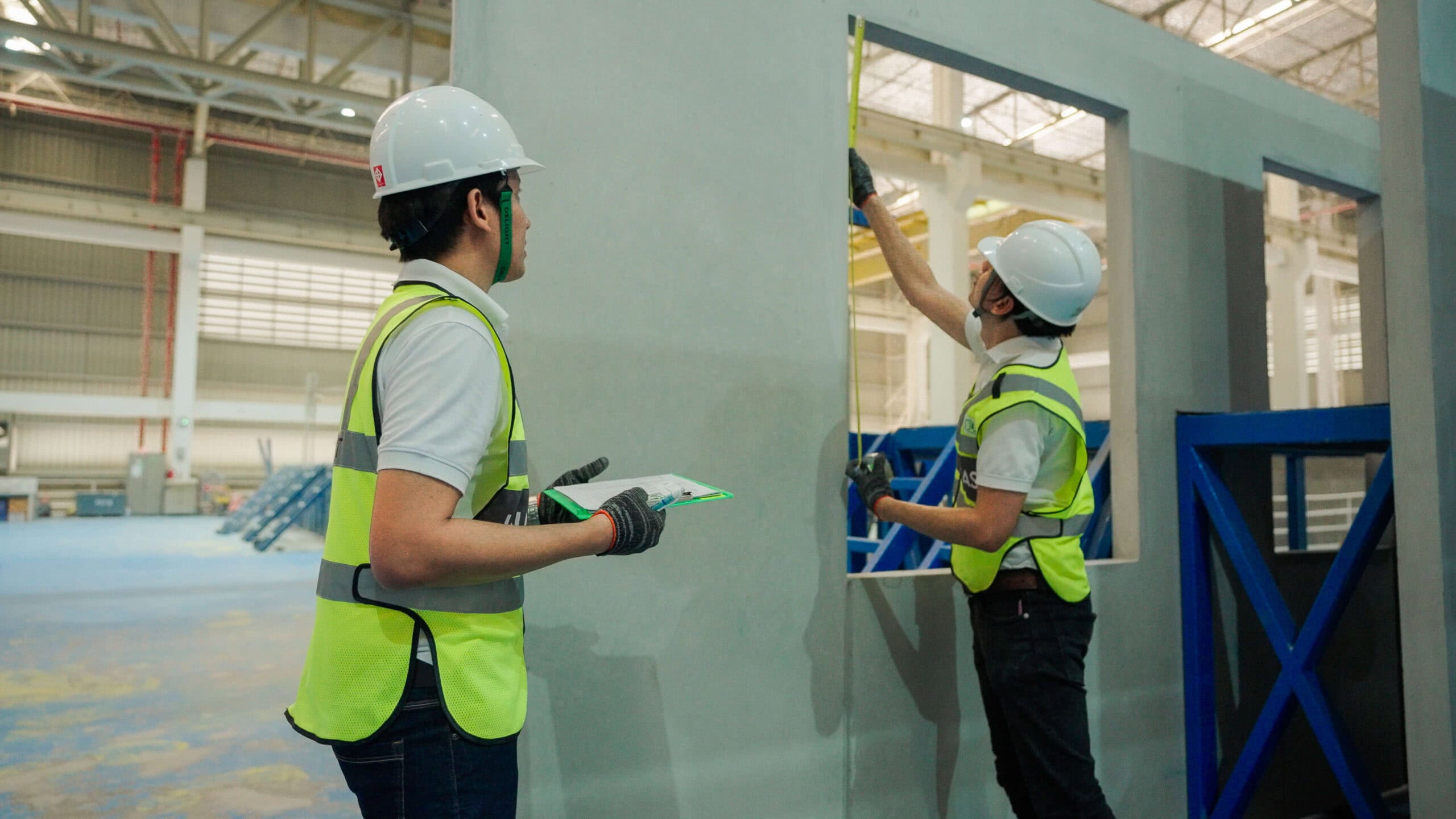
A key advantage of precast is factory-controlled quality, reducing on-site variability and ensuring better control of factors that affect fire rating—such as concrete density, production consistency, and dimensional accuracy.
Three Key Fire Performance Criteria: E – I – R
Fire resistance performance is commonly evaluated based on:
E – Integrity: The wall prevents flames and smoke from passing through.
I – Insulation: The wall limits temperature rise on the non-fire side.
R – Load Bearing Capacity: The wall maintains structural load-bearing performance during fire exposure (when applicable).
Different project types require different combinations—some require E+I (typical fire partitions), while structural elements may also require R.
Common Weak Points: Joints and Openings
Even with high-performance concrete, overall fire protection depends on addressing vulnerable areas:
Panel Joints: Gaps or improper sealants allow fire and smoke penetration.
MEP Openings (pipes, cables, trays): High-risk areas that require proper fire-stopping systems.
Connections to floors, beams, and columns: Must form a continuous fire barrier without gaps.
Why Precast Has an Advantage Over Conventional Wall Construction
1) Consistent, Verifiable Quality
Factory production ensures better control over density, thickness, and finish quality—reducing variability caused by on-site labor and conditions.
2) Faster Installation
Reduced wet works and faster installation minimize on-site errors and help maintain project timelines—supporting business continuity.
3) Systematic Design Integration
Precast systems allow more precise detailing of panel edges, joints, and anchor points to integrate effectively with sealing and fire-stopping systems.
What to Review in Fire-Resistant Precast Specifications
Before selecting a system, consider:
1.Fire compartmentation requirements
Identify areas requiring separation (production zones, warehouses, electrical rooms, etc.).
2.Joint and sealing systems
Clarify joint types, sealant materials, and continuity methods.
3.Opening protection and fire stopping details
Ensure clear standards for MEP penetrations and installation control.
4.Testing standards and documentation
Verify compliance with required fire resistance standards early in the design phase.
Inno Precast กับแนวทางผนังกันลามไฟ
At Inno Precast, we see fire-resistant precast walls not merely as products, but as complete wall systems that must perform in real emergency situations. We emphasize:
- Proper specification aligned with building type
- Detailed joint and penetration design
- Installation guidance and on-site quality control
- Consistent factory production standards
Our goal is to deliver both the speed of precast construction and enhanced safety performance.
FAQ
If concrete is already non-combustible, is additional fire spread specification necessary?
Yes. Fire spread control involves not only non-combustible materials but also continuous fire barriers—especially at joints and penetrations.
What are the most critical risk points?
Typically, joints and MEP openings, where improper detailing can compromise the entire system.
What types of buildings are suitable?
Factories, warehouses, electrical and mechanical rooms, high-safety zones, and projects requiring strict schedule and quality control.
A Fire-Resistant Wall Is a System—Not Just a Panel
Effective fire protection begins with proper design and material selection. Fire-resistant precast walls are a key Passive Fire Protection solution that helps slow and limit the spread of fire and smoke, extend evacuation time, reduce damage, and support business continuity.
If you are looking for guidance in selecting the right fire-resistant precast wall system for your building type and project requirements, the Inno Precast team is ready to provide consultation on specifications, joint detailing, and installation approaches to ensure real-world performance.